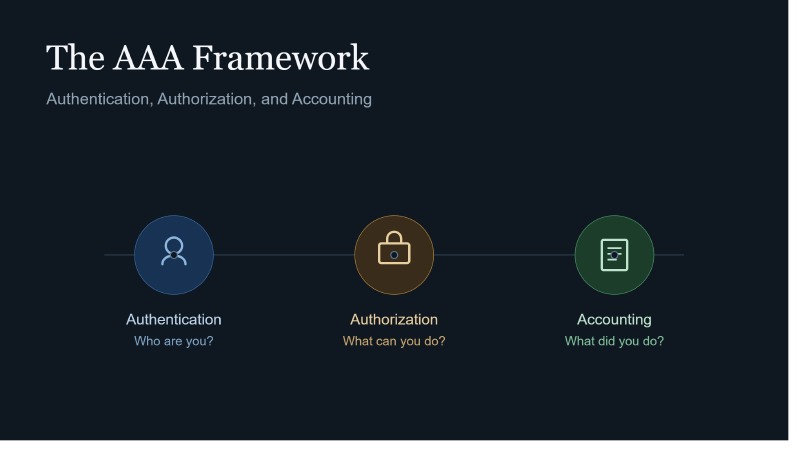
But what exactly is AAA? Before getting lost in technical jargon, let’s look at this not as a dry engineering document, but through a real-world scenario we all know: checking into a high-security hotel.
🔑 The Hotel Analogy and Its Technical Backdrop#
1. Authentication: “Who are you?”#
You walk up to the hotel front desk. Before the receptionist hands you any room key, what do they ask for first? Your ID or passport. The goal here is to verify that the person standing in front of them is actually the one who made the reservation.
- Behind the Scenes: This is the username and password prompt when an engineer tries to SSH into a router or switch. The network asks: Are these credentials valid? Is this person actually who they claim to be? In small networks, these credentials live directly on the device’s
local database. However, in enterprise environments, AAA forwards this request to a centralized server like Cisco ISE or Aruba ClearPass.
2. Authorization: “What are you allowed to do?”#
Your ID is verified, and the receptionist hands you a digital keycard. However, this card doesn’t open every door in the building. You can access your room or the gym, but if you swipe it at the penthouse suite or the main server room, the door won’t budge.
- Behind the Scenes: Successfully logging into a device doesn’t mean you have the right to change everything. In the Cisco ecosystem, there are default privilege levels ranging from 0 to 15. Thanks to AAA, we can implement Role-Based Access Control (RBAC). A junior intern might only be authorized to run monitoring commands (
show), while a senior engineer dynamically receives full configuration (config t) privileges.
3. Accounting: “What did you actually do?”#
It’s time to check out. The front desk hands you a detailed itemized receipt: what was taken from the minibar at 9 PM, which movie was watched at midnight… The hotel management logged your every move for security and auditing.
- Behind the Scenes: In network engineering, this is the ultimate digital paper trail. When a session opens, a
Startpacket is sent to the central AAA server, followed by aStoppacket when it closes. If a core switch suddenly crashes, logs are audited to pinpoint exactly who ran thereloadcommand and when. It’s not about playing the blame game; it’s about network auditing and visibility.
⚔️ The Protocol Wars: TACACS+ vs. RADIUS#
Now that we understand the concept, let’s talk production. In the real world, we connect our network devices to a centralized security server using two main protocols. Choosing between them depends entirely on what we are trying to protect.
| Feature | TACACS+ (The Device Manager) | RADIUS (The Gatekeeper) |
|---|---|---|
| Primary Use | Device Administration (Router/Switch Management) | Network Access Security (VPN users, 802.1X Wi-Fi) |
| Encryption | Encrypts the entire packet | Encrypts only the password field |
| Layer Type | Uses TCP (Port 49) - Reliable connection | Uses UDP (Port 1812/1813) - Faster, lightweight |
| Architecture | Separates AAA components completely | Combines Authentication & Authorization |
| Command Control | Per-command authorization (Crucial for CLI) | No granular CLI command control |
Why I Prefer TACACS+ for Infrastructure Management#
When managing enterprise routers and switches, TACACS+ is my clear winner. Encrypting the entire packet prevents our topology and command details from being sniffed over the wire. More importantly, because it separates Authorization from Authentication, every single time an engineer presses “Enter” on a CLI command, we can query the server in real-time: “Is this user allowed to run this specific command right now?” RADIUS simply cannot provide this level of granular control efficiently.
🚀 AAA in the Modern Era: Connecting with Zero Trust#
In traditional designs, AAA was mostly used to audit engineers accessing internal devices. However, in today’s Zero Trust architectures, the perimeter is gone. The philosophy of “I am inside the company network, therefore I am safe” is officially dead.
Consider another critical implementation: Site-to-Site IPsec VPN architectures. While secure encrypted tunnels prevent data from being intercepted in transit, how do we ensure the person initiating that tunnel from the other end is truly authorized?
This is where AAA shines in modern environments:
- When a remote or branch user requests access across the VPN, the gateway intercepts the request.
- Credentials are instantly passed to the central AAA server via RADIUS.
- The server checks context: Does the device have the right corporate certificate? Is the antivirus updated? (Context-Aware Authentication).
- If everything checks out, the user is granted access (
Authorization) to only the minimal network segment required for their job.
Ultimately, AAA is no longer just an old-school tool for managing routers; it is an indispensable security discipline sitting at the very heart of modern cybersecurity, VPN infrastructures, and Identity & Access Management (IAM) systems.