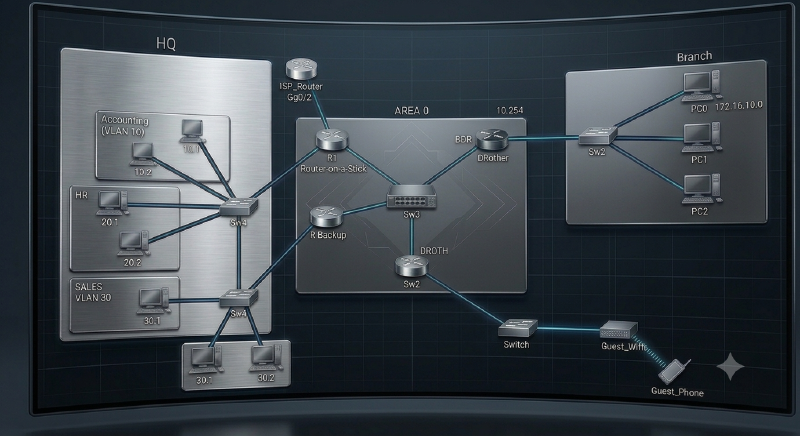
Project Overview#
This project focuses on simulating a multi-tier enterprise network architecture designed to meet corporate standards for scalability, redundancy, and structural security. It models a modern campus network with distinct core, distribution, and access layers, ensuring that logical boundaries align with engineering best practices.
Core Architecture & Technical Approach#
1. High Availability & Redundancy (HSRP)#
To prevent single points of failure at the default gateway level, Hot Standby Router Protocol (HSRP) is implemented at the distribution layer.
- Objective: It provides automated default gateway redundancy for critical VLANs, ensuring uninterrupted traffic flow if a primary layer-3 switch or router goes offline.
2. Dynamic Routing & Scalability (OSPF)#
Network-wide reachability is established using Single-Area OSPF (Open Shortest Path First).
- Objective: This approach ensures fast convergence, efficient path selection, and simplifies network expansion. OSPF areas and link costs are tuned to optimize bandwidth utilization across backbone links.
3. Segmentation & Security (VLANs & ACLs)#
Broadcast domains are strictly confined using local VLANs mapped to specific corporate functions (e.g., Management, IT, Operations, Guest).
- Objective: Inter-VLAN routing is strictly controlled via Access Control Lists (ACLs) to enforce a least-privilege access model, filtering unauthorized traffic before it reaches sensitive network segments.
4. Border Security & Internet Edge (NAT)#
To facilitate secure internet egress while conserving public IP space, Network Address Translation (NAT) — specifically Port Address Translation (PAT) — is configured at the enterprise edge.
- Objective: It hides internal IP schemas from the public internet, translating private addresses into reusable public endpoints, thereby establishing a basic layer of boundary defense.
5. Enterprise Mobility & Guest Access (Wi-Fi)#
Wireless connectivity is integrated into the campus network design, separating corporate internal traffic from guest traffic.
- Objective: Secure authentication mechanisms are simulated to ensure that wireless endpoints are dynamically funneled into their respective VLANs, preventing unauthorized access to core resources.